#3 (19) 2026
pdf-version
DOI: 10.24412/2782-5027-2026-3-7-20
Glazunova (Zavarina) E. N. Marking inscriptions and a features of the iconography of Saint Tsarevich Dimitry, associated with the image of the necklace and the wound on the saint's neck, made on shrouds in the mid-17th century in the Stroganov workshop
Glazunova (Zavarina) Ekaterina N. — conservator of textile of the 2nd сategory; the Grabar Art Conservation Center, conservator at the Department of Textile restoration
E-mail: zavarina.kat@yandex.ru
ORCID: 0000-0002-1806-9300
The article examines the marking inscriptions and the peculiarity of the iconography of Saint Tsarevich Dimitry, associated with the image of the necklace and the wound on the saint’s neck, revealed during the restoration of the shroud with the embroidered composition “The Annunciation of Ustyug” of 1655, created in the workshop of Anna Ivanovna Stroganova. The discovery of an inscription on the reverse side of the shroud allowed us to supplement a series of works of pictorial embroidery that came out of A. I. Stroganova's workshop in the mid-17th century, with similar surviving inscriptions. The iconographic features of the image of Tsarevich Dimitry under consideration are compared with works created in the 1620s and in the 1650s – 1660s in the Tsaritsa’s workshop under the leadership of Tsarina Maria Ilyinichna and the Stroganovs' workshop. The examples given, including those from the Stroganovs' workshop, testify to the stable iconography of the saint and the different approaches to the depiction of the wound. Along with images of the saint without a wound or necklace on the neck, there are a number of icons and embroidered works where this detail is highlighted and executed in various techniques: with an unsewn background of fabric, embroidered with pearls, gold and silver threads. A number of shrouds with the image of Tsarevich Dimitry, made in the 1650s and 1660s in the workshop of Anna Ivanovna Stroganova, show the various ways in which the necklace or the wound on the neck were highlighted, emphasizing the martyrdom of the saint.
Iconography, marking inscriptions, Old Russian embroidery, restoration, the Tsaritsa’s workshop, Tsarevich Dimitri, Tsaritsa Maria Ilyinichna, workshop of Anna Ivanovna Stroganova.
DOI: 10.24412/2782-5027-2026-3-21-35
Ippolitov S. S. Publishing in the Republic of Belarus in the context of sovereignty: state regulation and development prospects
Ippolitov Sergey S. — Doctor in Historical Sciences; the D. S. Likhachev Russian Institute of Cultural and Natural Heritage, Chief Researcher; Russian State Academy of Intellectual Property, Professor; The State Research Institute for Restoration, leading specialist
E-mail: nivestnik@yandex.ru
ORCID 0000-0003-3564-4271
The article presents a comprehensive analysis of the current state of the publishing system of the Republic of Belarus as a socio-communicative institution fulfilling the functions of cultural heritage accumulation, knowledge transmission, educational provision, and national identity representation. The relevance of the study is determined by the digital transformation of the media environment, shifting reading practices, intensifying geopolitical competition, and increasing information pressure on sovereign states — all of which highlight the urgent need to develop effective mechanisms for protecting the national cultural space. The paper examines the historical evolution of Belarusian book publishing — from the traditions originating in the activity of Francysk Skaryna in the 16th century, through the Soviet institutional model with its extensive network of state publishing houses, to the post-Soviet mixed system combining state and private structures while retaining a significant regulatory role of the state. Special attention is paid to the legal framework of the industry: key legislative acts are analyzed, including the special Law “On Publishing in the Republic of Belarus,” as well as the functions of the Ministry of Information and the National Book Chamber as institutional centers of state policy in this sphere. Based on empirical data, including statistics from the National Statistical Committee and the results of an analysis of literature lists recommended for library procurement in 2025, the linguistic structure of published materials is identified. A correlation is established between the share of publications in the Belarusian language (35.26%) and the actual linguistic practice of the population (26% of citizens use Belarusian at home), which is interpreted as a deliberate state policy aimed at preserving the national language amid information confrontation. The article also highlights the directions of Russian-Belarusian cooperation in the publishing sphere, including mutual exchange of literature, joint projects (textbooks on common history, publications on the Great Patriotic War), and the coordination of approaches to countering the dissemination of destructive content. It is concluded that the publishing industry of Belarus, while maintaining institutional stability and adapting to external challenges, remains a key instrument of sovereign cultural development and integration cooperation within the framework of the Union State. At the same time, the paper emphasizes the lack of comprehensive interdisciplinary research covering the systemic interrelation of structural, regulatory, and dynamic aspects of Belarusian book publishing.
Artificial intelligence, book publishing, integration processes, publishing in Belarus, sanctions pressure, scientific literature, sovereignty, state regulation, the book market, the Union State.
DOI: 10.24412/2782-5027-2026-3-36-55
Kadikova I. F. Materials and technological features of the wall paintings in the Altar of the Church of the Savior on the Threshold (1675) at the Rostov Metropolitan’s House
Kadikova Irina F. — The State Research Institute for Restoration, Head of the Laboratory of Physicochemical Research
E-mail: kadikovaif@gosniir.ru
This study conducts a technological analysis of the art materials used in the wall paintings of the altar area of the Church of the Savior on the Threshold (1675) at the Rostov Metropolitan’s House. In the course of the work, 130 paint layer samples taken from various narrative compositions, ornaments, and individual images of saints were examined. The application of a complex of modern physicochemical methods, including optical polarized light microscopy, scanning electron microscopy with energy-dispersive X-ray spectroscopy (SEM-EDS), and FTIR microspectroscopy, allowed not only for the identification of the material composition, but also for a detailed study of the paint layer stratigraphy, revealing both historical overpainting from the second half of the 19th century and restoration materials from the late 20th century. The analysis established that the core of the original 1675 palette consisted of a pigment set traditional for this period: lime white, artificial azurite, smalt, glauconite, vermilion, and ochres of various colors. In turn, the overpainting layers of 1863 and 1893 were found to contain lead white, artificial ultramarine, Prussian blue, cobalt blue, chrome yellow, alizarin (PR 83), red lead, and verdigris, which is rare for this period. The data obtained enable the objective differentiation of chronological painting layers and provide a solid methodological framework for developing conservation programs for the unique ensemble of the Rostov Metropolitan’s House.
17th-century wall painting, art materials, artificial azurite, calcium oxalates, Church of the Savior on the Threshold, pigments, Rostov Kremlin, smalt, technological investigation, verdigris.
DOI: 10.24412/2782-5027-2026-3-56-70
Kotelnikov P. N., Mikhailova A. V., Natsky M. V., Ravich I. G. Composition and features of destruction of Russian cast cabinet sculpture of the late 19th – early 20th centuries, made of brass
Kotelnikov Pavel N. — restorer of the highest category of metal works; The State Research Institute for Restoration, head of the department of scientific restoration of metal works
E-mail: pvl.kotelnikov@yandex.ru
Mikhailova Anna V. — The State Research Institute for Restoration, Department of Scientific Restoration of Metal Works, junior researcher
E-mail: mikhannavlad11@gmail.com
Natsky Mikhail V. — restorer of the highest qualification, The State Research Institute for Restoration, Department of Scientific Restoration of Metal Works, restorer
E-mail: mike.natsky@gmail.com
Ravich Irina G. — Dr. Ph. D., The State Research Institute for Restoration, Department of Scientific Restoration of Metal Works, leading researcher
E-mail: ravich41@mail.ru
The article is devoted to determining the composition of Russian cabinet sculpture of the late 19th – early 20th centuries cast from brass and studying the characteristics of its destruction. The aim of the work is to study the possible relationship between the composition, design features and nature of destruction of sculptures for the subsequent development of methods for their restoration. The research was based on samples of sculptures collected by A. F. Dubrovin, who was unable to analyze them due to his untimely death in 2015, as well as sculptures from museums and private collections undergoing research and restoration at the State Research Institute for Restoration, Metal Department. The composition of the products was determined using the non-destructive method of X-ray fluorescence analysis (XRF) on a HitachiX-Met8000 device and using scanning electron microscopy on a HitachiTM4000Plus device with an attachment for micro-X-ray spectral analysis Quaniax 75 (Bruker). As a result of the analysis of 41 sculptures and the construction of histograms of their composition, a standard norm of zinc (25–30%) and lead (1–5%) content was identified, which was adhered to by Russian masters during the period under consideration. The metal of all the products was distinguished by its purity, containing no more than tenths of a percent of iron; other elements in quantities of tenths of a percent (nickel, manganese, silicon, magnesium) were found sporadically. The results obtained with further accumulation of data can be used in the attribution of Russian cabinet sculpture. It has been established that the destruction of the cast brass cabinet sculpture is not due to its composition, but to the peculiarities of its design, which leads to the appearance of cracks due to internal stresses.
Brass, cabinet sculpture, casting, composition, destruction, Russia, scanning electron microscopy, X-ray fluorescence analysis.
DOI: 10.24412/2782-5027-2026-3-71-79
Krasilin M. М., Nikolaev K. A., Skorokhod A. A. Unknown paint by Willem van de Velde JR. Experience of attribution
Krasilin Mikhail М. — the State Research Institute for Restoration, Senior Researcher of the Scientific Expertise Department
E-mail: m.krasilin@mail.ru
Nikolaev Kirill A. — The State Research Institute for Restoration, Head of the Scientific Expertise Department
E-mail: kirill.pochta@mail.ru
Skorokhod Alexander A. — The State Research Institute for Restoration, Junior Researcher of the Scientific Examination Department.
E-mail: skorohodios@yandex.ru
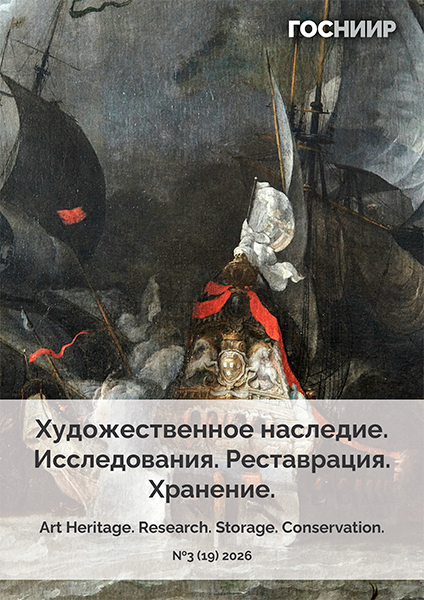
The article is devoted to the study of a previously unidentified work by the 17th-century Dutch marine painter Willem van de Velde Jr., one of the greatest masters of seascape in the late 17th and early 18th centuries, and presents the experience of its attribution based on a comprehensive art historical analysis. The relevance of the work is due to the need to clarify the range of the master's works and expand the understanding of his creative heritage. It should also be noted that the works of Willem van de Velde are poorly represented in domestic collections, which increases the scientific significance of each newly identified or re-attributed work. The purpose of the study is to determine the degree of probability of Willem van de Velde’s authorship of the painting in question and to identify its place in the evolution of the artist's artistic style. The study employs an interdisciplinary approach that includes stylistic, comparative-iconographic, and technological analysis, as well as the study of the painting's provenance.
17th-century art of Northern Europe, attribution, Dutch art, Dutch marine painting, Dutch painting, expertise, Willem van de Velde Jr.
DOI: 10.24412/2782-5027-2026-3-80-94
Makarova A. S., Kiryanova O. G., Yuryeva T. V., Koluntaev D. A. Research and restoration of tombstones from the lapidary collection of the Krutitsky Patriarch's Compound
Makarova Anastasia S. — PhD. cult., restorer of the I cat.; the State Research Institute for Restoration, Academic Secretary
E-mail: aanpilogova@mail.ru
Kiryanova Olga G. — The State Research Institute for Restoration, junior research associate of the Scientific and Organizational Department
E-mail: psk-ok@mail.ru
Yuryeva Tatyana V. — he State Research Institute for Restoration, Research fellow of the Laboratory of Physicochemical Research
E-mail: tvyur@yandex.ru
Koluntaev Dmitry A. — PhD in Biological Sciences; Saitegra LLC, Leading Specialist in Mass Spectrometry
E-mail: Koluntaev@gmail.com
This article examines the process of research and conservation of three tombstones from the collection of the Krutitsy Patriarchal Metochion. The metochion's lapidary collection currently comprises 123 items. Some are on display in situ, while others are part of several exhibitions created within the metochion. Three of the steles — the tombstone of Metropolitan Barsanuphius (1688), the tombstone of Metropolitan Triphyllius (1701), and the tombstone of Hieromonk Adrian (1716) — retain traces of decorative painting. Technical and technological research revealed that the surface of the letters on the slabs of Metropolitans Barsanuphius and Triphyllius were gilded, the sides of the letters and the background of the inscriptions were painted blue with artificial azurite, and the background of the floral ornament was painted red with lead-based paint. On Hieromonk Adrian's tombstone, the initials of the words, the image of a four-pointed cross, and some of the ornamental decoration were painted red (red lead pigment). The remaining text and small ornamental elements were painted black. Furthermore, microbial marker analysis revealed a significant number of anaerobic microorganisms in the samples taken from the surface of Metropolitan Trifilly's tombstone. This allowed us to reconstruct the history of the monument, which likely remained buried in the ground for a long time.
Anaerobic bacteria, conservation, gas chromatography-mass spectrometry, Krutitsy Patriarchal Metochion, lapidary collection, paint layer, tombstone.
DOI: 10.24412/2782-5027-2026-3-95-100
Mishcherina S. M. Accounting work in church museums as a basis for preserving funds and ensuring continuity
Mishcherina Svetlana M. — the director of the Diocesan House-Museum of the Hieromartyr Onufriy (Gagalyuk)
E-mail: mischerina@mail.ru
This article examines the lack of a unified, systematic approach to the accounting and curation activities of church museums, which creates risks of loss, substitution, and distortion of the origin and semantic context of museum objects. This problem is, in some cases, significantly exacerbated by the lack of continuity among museum specialists, their lack of professional training, and the geographical remoteness of some museums. The task of every museum professional is to minimize such risks. The article also notes a characteristic feature of many church museums, which fundamentally distinguishes them from secular ones: the presence of liturgical life within their walls and the use of objects of museum significance during services. This, in turn, raises the question of accounting for and ensuring the preservation of such objects. The author concludes that it is necessary to create a methodological center to coordinate the work of all diocesan museums, regardless of their size and subordination, because unified approaches to organization of work in general and accounting principles in particular contribute to the data comparability between dioceses, simplify the interaction with state museums and archives, and create the basis for nationwide church catalogs and registers. Accounting and curatorial work in a church museum is responsible for the memory, continuity, and preservation of church property, entrusted to museum staff as custodians, not owners.
Accounting and curatorial activities, church museums, data comparability, interaction with state museums and archives, methodological center for diocesan museums, museum objects, risks of loss and misrepresentation of provenance, unified accounting principle.
DOI: 10.24412/2782-5027-2026-3-101-111
Morozova E. A. Watercolor or colored ink? A technological study of early works by A. Lentulov
Morozova Ekaterina A. — The State Research Institute for Restoration, Researcher of the Laboratory of Physicochemical Research
E-mail: morozovaea@gosniir.ru
This article presents the results of a technical study of Aristarkh Lentulov’s early graphic works. The aim of the research was to identify the materials used by the artist and to clarify his painting technique. The subjects of the study are the painting “Moscow. View of Bersenevskaya Embankment: the Church of St. Nicholas the Wonderworker and Hydroelectric Power Station No. 2” from a private collection, as well as three of the artist’s works from the collection of the V. I. Dal State Museum of the History of Russian Literature. The scientific novelty of the study lies in establishing that A. Lentulov used coloured ink during his early creative period. Furthermore, the triarylmethane dyes “Methyl Violet” and “Victoria Blue” — previously unrecorded in Russian literature on the study of artistic materials — have been identified for the first time within the paint layer of these graphic works. Particular attention is paid to the identification of the binder and synthetic organic dyes, the assessment of the potential of spectroscopic methods in the analysis of graphic works, and the technological characteristics of coloured ink. The author concludes that the visual features of a graphic work cannot serve as a sufficient basis for determining the painting technique, and that a comprehensive technological study is an important tool for the attribution, expertise and reconstruction of A. Lentulov’s artistic practice.
A. Lentulov, art expertise, colored drawing ink, Methyl Violet, organic dyes, painting technique, Shellac, technological study, Victoria Blue, watercolor.